Monday, October 8, 2012

Five Talking Points to "All Quiet on The Western Front"
  • How awful war is
  • The effects of war on those that are fighting
  • The pressures to join the war (patriotic idealism)
  • How war changes people into people that they are not (animal like behavior)
  • The cheapness of human life

Tuesday, October 2, 2012


Chapter Eleven

In chapter eleven of the novel All Quiet on the Western Front, by Erich Maria Remarque, many tragic events are described. This chapter is one of sorrow and despair, filled with death. Each word in this chapter makes the reader feel the pain of the solider, the pain of loss and death of those around him. It condemns the characters worst fears of losing those that he has come closest to on the battlefield.
            “War is the cause of death like cancer and tuberculosis, like influenza and dysentery”. (pg271) This quote alone sets the stage for this chapter of gloom. The main character talks of how each day passes practically unnoticed.  How each of them have grown so accustom to the war their minds have ceased to think of nothing else. How no man remembers what life outside the war could possibly be like. “It is as though formerly we were coins of different provinces; and now we are melted down, and all bear the same stamp”. (pg272) The main character goes on to talk about how the death all around them has left them as animals.
            This chapter tells of how Detering, having seen a cherry tree, goes, in a sense mad, for his longing of home has surpassed his control. The main character, Paul, tells of how one morning Detering was gone. He goes on to say that Detering had absurdly gone toward Germany, and so was caught by the field gendarmes; military police. We then hear no more about Detering, for the main character himself hears nothing of him. Müller, one of the main charcters, we learn is dead. We go on to find out that he was shot at point-blank in the stomach. He lives for a short time longer, but in utter agony.
            “Germany out to be empty soon,” says Kat’. (pg 281) At this point in the book the characters seem to be loosing hope that the war will ever end. German forces do not have the food, the artillery, or any such supplies to match the competitors. “For one hungry, wretched German soldier come five of the enemy, fresh and fit” (pg286).
            Leer, a character that went to school with the main character, Paul, has been shot. The boy bleeds out, at the same time Bertinick the Company Commander is shot. Soon after, the main character and Kat have been hit, Kat is hit in the bone, and bleeds fast. Paul carries Kat over his shoulder, stopping to get out of the way of the firing that is over them. Paul makes it to the shelter where the doctors and surgeons can tend to Kat, but only to find that his work has been for nothing. Kat is dead. “Only the Militiaman Stanislaus Katczinsky has died. Then I know nothing more” (pg 291).
 

Part 2: Describe a Character

Stanislaus Katczinsky

                     Stanislaus Katczinsky from be beginning looks to be a father figure. In the beginning he seems to have a positive or at least a not-defeated view of the war stating it would not be such a bad war if only they could get some sleep. He is described as the leader of the group. A man who is “shrewd, cunning and hard bitten...” with “a remarkable nose for dirty weather, good food and soft jobs.”(pg03). Later it is said that he has to have a sixth sense for finding supplies. During most of the hard times he and his comrades go through he is the one to find something to cheer up his comrades, most of the time it is either food or somewhere to sleep. Though the story behind it is not mentioned in the novel it is said his greatest accomplishment in the area would be to finds a few crates of lobster for the men. At one time while being bombarded and running low on food there are multiple attempts to get food to the front. Then it is stated “Finally Kat tries, and even he reappears without accomplishing anything” (pg107) Food great necessity in the book and because of this Kat is a great friend to have. One such occasion when they were going hunger he and Paul go and steal geese to eat and use the feathers for a pillow. However it is not just good times for Kat. He seems to also have to make hard decisions in order to protect his younger followers. One such example would be when after rescuing a soldier and he realizes that the soldier is going to die, he asks the hard question to end it for him so as to keep the young soldier from suffering.
Most of the time Kat has a veteran like position to him. Where most of the men in the story are somewhere near 18 or 19 years old Kat is 40. The majority of times when the narrator is talking about older soldiers, it is in jealous nature. He and his friends were thrown into the fray at a young age with no life experience to help them after the war and little to cling onto to keep sane such as a wife or children. However Kat often gives helpful advice and is shown to be like a sort of wise elder to listen to and respect even though he does not out rank them. Other times he seems to be in a daze. One such time is when he is talking about men getting literally getting blown out of their clothes by mortars. He is killed in the end by a stray piece of shrapnel to the back of his head as he was being carried by Paul back to the medical area in order to treat his leg. He is the last of the group to die besides the narrator Paul, and was probably Paul’s closest friend. After Kat dies the book skips some time to when Paul is sent to rest for inhaling some poison gas which to me is a sign that Paul has given into depression and most likely does not care too much about the time after Kat dies.
           

Tuesday, September 18, 2012

Click here for CDU Presentation

Sources for PowerPoint:
http://en.wikipedia.org/wiki/Angela_Merkel -slide 3
http://en.wikipedia.org/wiki/Volker_Kauder -slide 4
http://en.wikipedia.org/wiki/Konrad_Adenauer -slide 12


Christian Democratic Union (CDU)


The Christian Democratic Union (CDU) is a major political party in Germany. It was created in 1945 right after World War II had ended. It is currently the second largest political party in Germany, having approximately 484,000 members. It has a sister party which is called the Christian Social Union of Bavaria (CSU). Together these two parties make up what is called the Union. The CDU is the second largest party in Germany. Currently the leader of the CDU is Angela Merkel, who also happens to be the Chancellor of Germany. With that being said, let’s now take a look at the values of the CDU.

The CDU is based on Christian values and relates to principles of the Christian Democracy. It supports a free market economy along with social welfare programs. Although it supports both of these it is still viewed as very conservative.  Its’ members come from many different religious backgrounds, some even coming from a non- religious background. Although it is the second largest political party it still has a few opponents. The opponents consist of the Social Democratic Party of Germany, The Left Party, and The Greens.
As mentioned earlier it has a sister party that is that CSU. Both of these parties have very similar views when it comes to federal policies. The only main difference between the two parties is that the CSU is a little bit more socially conservative compared to the CDU.

Today the CDU has many organizations. Some of the most known organizations of the CDU are the Junge Union, Christian Democratic Employees’ Association, Evangelical Working Group of the CDU/CSU, and the Association of Christian Democratic Students. 

Since 1950 the CDU has had 5 different German Chancellors from the CDU. The very first was Konrad Adenhauer, who was also the first Chancellor of the Federal Republic of Germany. Today Konrad has a foundation named after him called “The Konrad Adenhauer Foundation.” After Konrad’s 14 years of serving the CDU, Ludwig Erhard took over. He is most known for the Germany economic postwar reform and economic recovery.  After his three year of serving, Kurt Georg Kiesinger took over for the next three years. Next in office was Helmut Kohl. Helmut is now well known for his architects of the German reunification. After Helmut’s 16 years in office, Angela Mekel took over. She is Germany’s present day Chancellor of the CDU. She also happens to be the first female Chancellor of Germany.

Sources for Summary:
 http://en.wikipedia.org/wiki/Christian_Democratic_Union_%28Germany%29
 http://en.wikipedia.org/wiki/Konrad_Adenauer
 http://en.wikipedia.org/wiki/Ludwig_Erhard
 http://en.wikipedia.org/wiki/Kurt_Georg_Kiesinger
 http://en.wikipedia.org/wiki/Helmut_Kohl
 http://en.wikipedia.org/wiki/Angela_Merkel
CDU Presentation

Wednesday, August 29, 2012

The State of Bremen

Location: Northern part of Germany
http://www.ibiscus-residence.com/images/mappe/Germany-map.jpg

Population:
Bremen: 547,340            
Bremerhaven: 113,366

Total Population:  660,706
        
Size:
126 sq miles. (Smallest amongst Germany's 16 States)
http://en.wikipedia.org/wiki/Bremen


Main Industries:

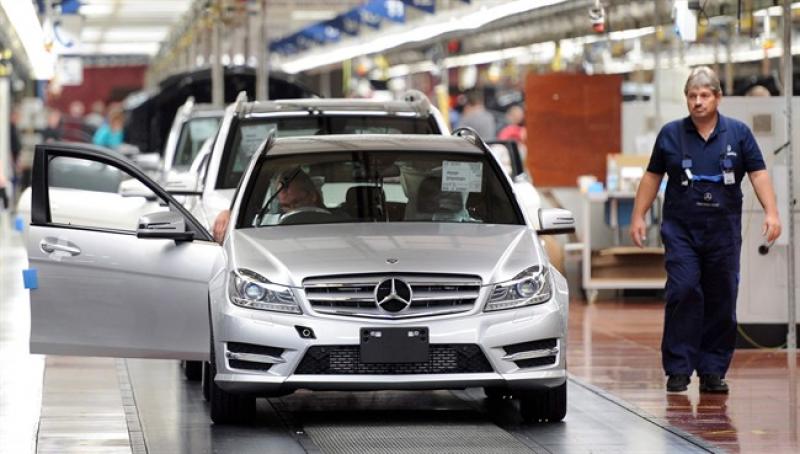
Car Production
  • 2nd largest in Europe
  • Manufactures many vehicle models which include Chrysler and Mercedes Benz
  • Has a workforce around 13,000 people


http://wfpquantum.s3.amazonaws.com/images/autos/articles/ultra/fc9d9jo4jhwyr0ywjpnf-6279020.jpg

Aerospace and Aviation Industry 
-One of the leading centers in Germany's for aerospace
-employs around 4,000 employees

(http://www.big-bremen.de/en/daten_fakten_inhalt_text?sv[id]=141678)
Food and Beverages  
-Home to many well known names such as Kellogg’s, Kraft, and Anheuser-Busch.
(http://www.big-bremen.de/en/daten_fakten_inhalt_text?sv[id]=141678)

Information Technology, Mobile and Wireless Technology
-Very technologically advanced city
(http://www.big-bremen.de/en/daten_fakten_inhalt_text?sv[id]=141678)
GDP: Approximately $39 billion in 2011
http://en.wikipedia.org/wiki/List_of_German_states_by_GDP


Background Information on Bremen

  • Bremen consists of 2 cities, The largest city in Bremen is Bremen consisting of an Estimated population of 547,340 people.
  • The 2nd city is Bremerhaven consisting of an estimated population of 113,366.
  • Bremen is located on the northwest side of the Weser River in Germany.--Bremerhaven has Germany’s second largest port, following Hamburg.
  • Bremerhaven's products include: ships, aircraft, steel machinery, electrical equipment, textiles, and beer. 
  • It is a commercial and industrial center in trading cotton, wool, tobacco, and copper. 
http://www.infoplease.com/ce6/world/A0808837.html, Aug. 30, 201

Places to see:  

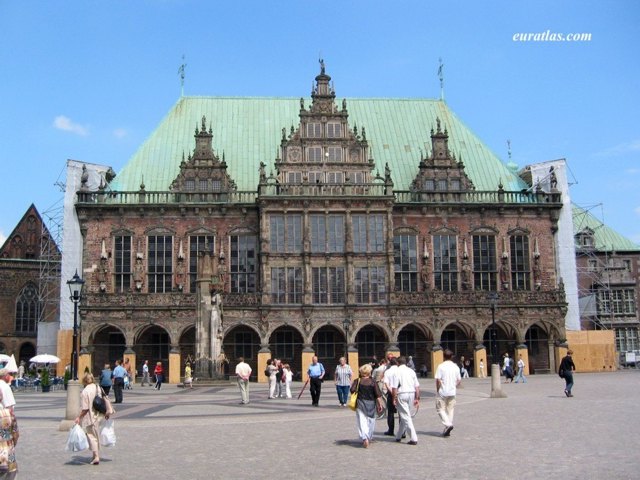
Bremen Town Hall- 
  • dates back to the15th century 
  • one of the most important examples of Brick Gothic architecture in Europe


http://www.euratlas.com/Atlas/germany_north/bremen_city_hall.jpg
Becks Brewery- 
  • Well known brewery around the world. Dates back to 1879.
http://cdn-locations-images.tripomatic.com/img-poi9120-qVcwyO-m.jpg
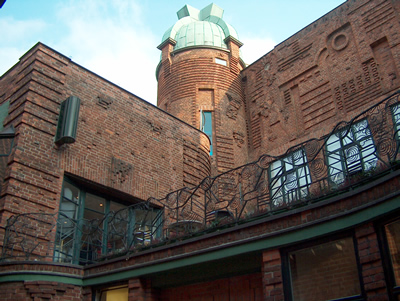
Bottcherstrasse
  • known as the "museum street" 
  • very famous for its unusual architecture


http://www.kunsttrip.nl/images/bremen/het%20bottcherstrasse%20bremen.jpg

A Brief History of Bremen and Interesting Cultural Information

 -In 787 under the rule of Charlemagne, Bremen became bishopric and a base for missionary activity. In 847 it became archbishopric.
-Bremen joined the Hanseatic League in 1358, then the Free Imperial City in 1646.
-In 1806, the Free Imperial City of Bremen became an sovereign state title Free Hanseatic City of Bremen. Their currency was the Bremen thaler until 1873.
-In 1827 Bremen bought land from Kingdom of Hanover, where Bremerhaven (literally translates as Bremen's Harbor) was established.
-Bremen became part of North German Confederation in 1867, then an autonomous component state of the German Emprire in 1871.
-Under the Third Reich, Bremen became a regular city in 1935 and wasn't reestablished as a state until 1947.
-In 1949, Bremen joined the Federal Republic in German. 

http://www.indianchieftravel.com/en/germany/bremen/bremen/bremen-germany-1, Sep. 2, 2012
http://en.wikipedia.org/wiki/Bremen_%28state%29, Sep. 2, 2012

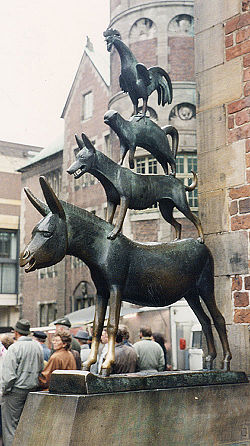
  Bremen Town Musicians
-Featured in Brother's Grimm story
-Rumored if you rub the donkey's leg while making a wish, the wish will come true

http://upload.wikimedia.org/wikipedia/commons/thumb/1/14/Bremen.band.500pix.jpg/250px-Bremen.band.500pix.jpg

Ratskeller
-Germany's oldest wine  cellar
-Dates back to 1409
-Featured in a verse of a poem by Heinrich Heine
-Setting for Phantasein im Bremer Ratskeller by Wilhelm Hauff  


http://www.szenenight.de/images/eventlist/venues/ratskeller_1287058646.jpg

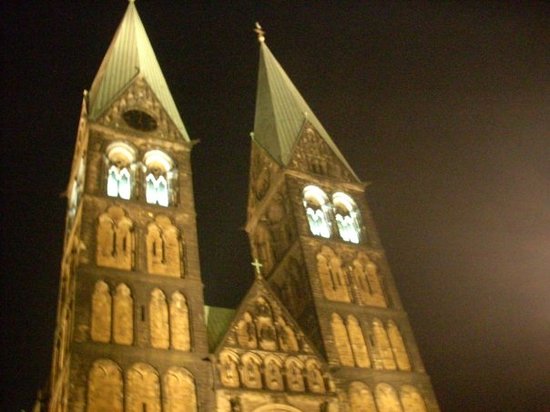
St. Peter's Cathedral
-99 meters tall
-No structure in Bremen is taller than the Cathedral

http://media-cdn.tripadvisor.com/media/photo-s/01/6b/01/3d/st-peter-s-cathedral.jpg

Statue of Roland 
-Medieval hero, Bremen's city protector
-Erected in 1404 as symbol of city's freedom
http://www.monkeysandmountains.com/wp-content/uploads/2011/02/things-to-do-in-bremen_roland-statue.jpg
http://www.bremen-tourism.de/bremen-at-a-glance, Sep. 2, 2012


 Gunter Meisner 
  • Born April 18th, 1926 in Bremen, Germany 
  • Played Mr. Slugworth in Willy Wonka and the Chocolate Factory in 1971 
  • Died of heart failure in Berlin at the age of 68

https://blogger.googleusercontent.com/img/b/R29vZ2xl/AVvXsEheIJ7X4XvaXk8aTanUgUxwQDDnqVTJKpPhWLZ83AbKCwdNPbh-bZt02WuGnU3o9afY1bauP5GkxiezyAq2m4BwbmpyblTVgLBV7npi8sNWJcdCe3vew42grcmi3uJxrxdNabPTHLlsun4/s1600/gal_wonka_gunter_meisner.jpg


Bremen Flag
http://www.flags-and-anthems.com/media/flags/flagge-bremen.gif